Playbook
The automated first draft vs. what the founder reads
Every month, a founder should get a short note on what changed in the numbers and whether it matters. Most don’t, because writing it means comparing every P&L line to last month and to budget, tracing the transactions behind each change, and then deciding what’s worth saying.
We automate the first part. The automation compares each line, finds the transactions that drove the change, and drafts a note for anything that moved past a set threshold. It’s good at the arithmetic.
What it can’t know is context. So the version a founder reads is written by a person. Here are three examples, with example numbers (not a client’s books).
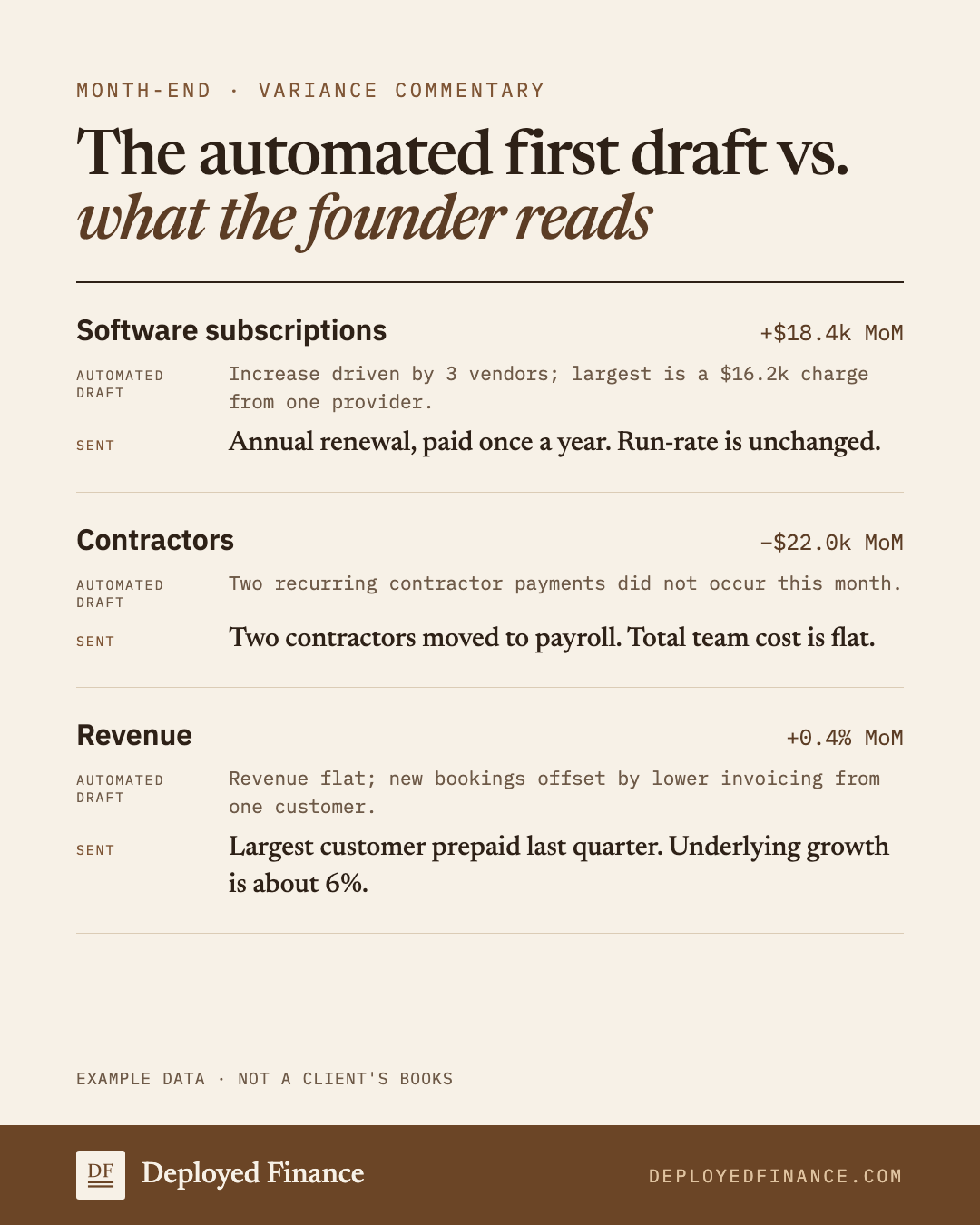
Software subscriptions: up $18.4k month over month
Automated draft: Increase driven by three vendors; the largest is a $16.2k charge from one provider.
What the founder read: Annual renewal, paid once a year. Run-rate is unchanged.
The draft is accurate. It just doesn’t answer the question the founder actually has, which is whether software spend is creeping up. It isn’t.
Contractors: down $22.0k
Automated draft: Two recurring contractor payments did not occur this month.
What the founder read: Two contractors moved to payroll. Total team cost is flat.
Read on its own, the draft suggests savings. The real story is a reclassification, and the cost shows up in payroll instead.
Revenue: up 0.4%
Automated draft: Revenue flat; new bookings offset by lower invoicing from one customer.
What the founder read: The largest customer prepaid last quarter. Underlying growth is about 6%.
This is the one that changes decisions. “Flat” invites a worried board conversation. The prepayment explains it, and the underlying number is healthy.
What a person adds
The automation gets the numbers and the transactions right. A person adds three things:
- Context the data doesn’t hold: renewals, reorganizations, prepayments, one-time events.
- Editing. Most lines that moved don’t need a sentence. Cutting them is part of the job.
- The “so what.” Every note that stays should answer one question: is this a problem, and what do we do about it?
The draft gets you most of the way. The judgment about what matters this month is still a human call.
What this changes
- Commentary arrives with the close, not a week after it.
- Board and investor updates get easier, because the explanations are written every month instead of reconstructed each quarter.
- The founder reads three useful sentences instead of thirty lines of arithmetic.
If you want monthly reporting that explains itself, book a 30-minute intro.
Want this running on your books? Book a 30-minute intro.