Playbook
What's left after the automation does the bank reconciliation
Bank reconciliation is where small mistakes hide. A duplicate charge, a refund booked as income, or a payout netted against fees each looks like nothing on its own. Left alone for a few months, they turn into a cleanup project and an awkward question in diligence.
We automate the matching. What we don’t automate is the judgment about what’s left over. Below is what that looks like in a typical month, using example numbers (not a client’s books).
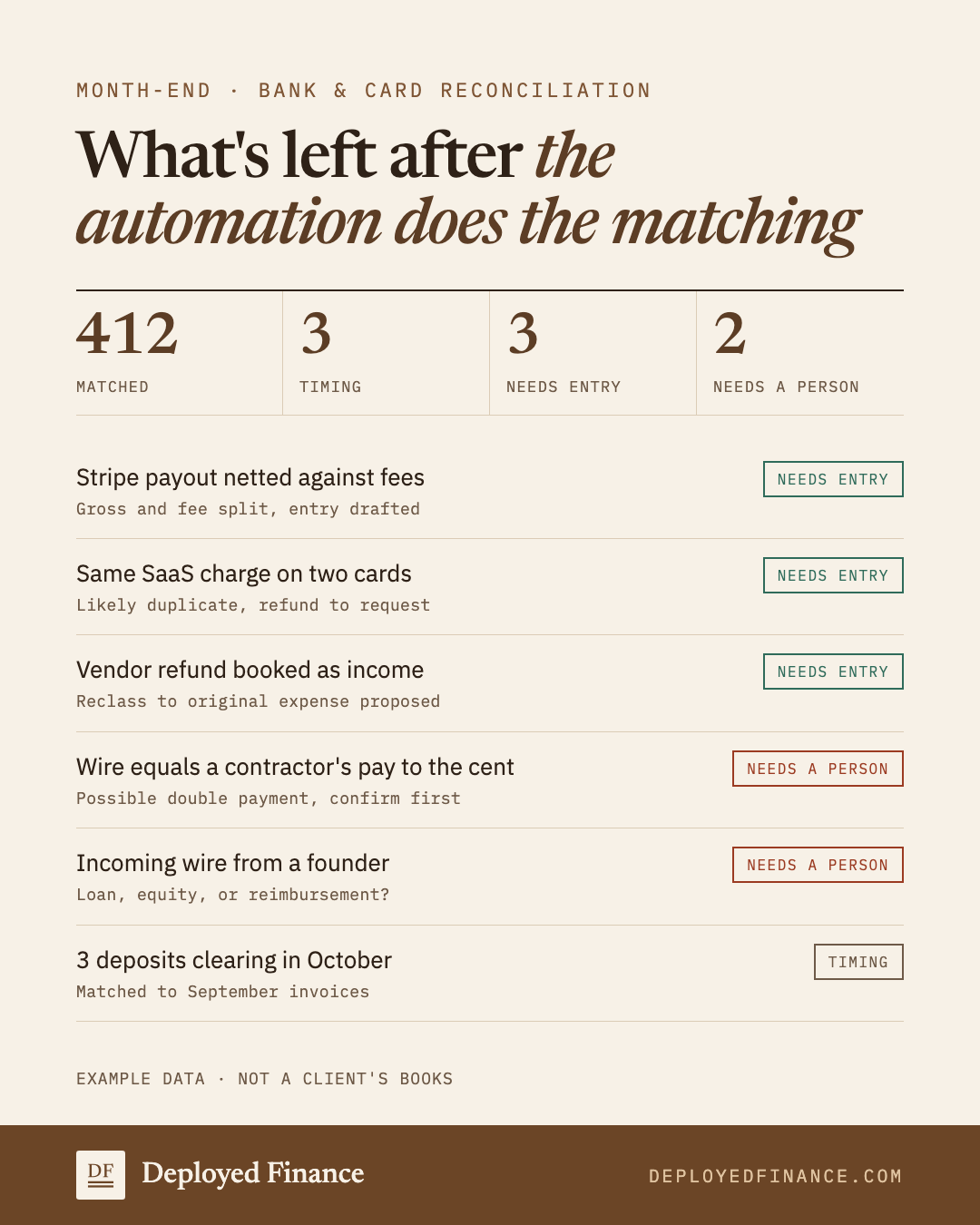
Most of it clears on its own
In this example month, 412 bank and card transactions matched cleanly to the books, the payment processor’s payouts and the payroll register. Nobody needs to look at those line by line, and nobody should be paid to.
The value is in the eight that didn’t match. They fall into three buckets, and each one gets handled differently.
Bucket 1: Timing (3 items)
Three deposits cleared in October against September invoices. Nothing is wrong. They’re listed so the reconciliation explains every difference between the bank and the ledger, and they’re checked again next month to make sure they actually cleared.
Bucket 2: Needs an entry (3 items)
These are mistakes with a clear fix, so the automation drafts the correcting entry and a person approves it:
- A processor payout netted against fees. The deposit was booked as the net amount. The fix splits it into gross revenue and processing fees, so both lines on the P&L are right.
- The same software charge on two cards. Likely a duplicate subscription. The entry is drafted, and someone asks the vendor for a refund.
- A vendor refund booked as income. It’s reclassed against the original expense, so revenue isn’t overstated.
Bucket 3: Needs a person (2 items)
These need context that isn’t in the data:
- A wire that matches a contractor’s pay to the cent. It could be a double payment. Someone confirms with the contractor before anything is booked.
- An incoming wire from a founder. Is it a loan, equity or a reimbursement? Each one is booked differently and has different consequences. Only the founder can answer, so they’re asked.
The automation is good at finding patterns. It can’t know that a vendor changed its legal name, or what a founder meant by a wire. That’s what the third bucket is for.
What this changes
- The close stops waiting on reconciliation. The matching is done when the month closes, not two weeks later.
- Every difference is explained. The reconciliation shows what’s timing, what was fixed and what’s still open, so nothing quietly carries forward.
- People spend their time on the eight items, not the 412. That’s where errors actually live.
Why the buckets matter more than the matching
Matching software is easy to find. The work that makes a reconciliation trustworthy is deciding what counts as each bucket for a specific company, catching what an automated match gets confidently wrong, and making sure a person actually closes out every exception each month. That’s the part we build and run for clients.
If you want your reconciliations running this way, book a 30-minute intro.
Want this running on your books? Book a 30-minute intro.